Q4 Nurture Rebuild: An MQL nurture that knows why each lead arrived
I rebuilt the inbound MQL nurture from three generic persona tracks into one eight-email sequence that opens by naming why each lead arrived, with a clean plain versus visual test and reporting that counts meetings and SQLs instead of opens.
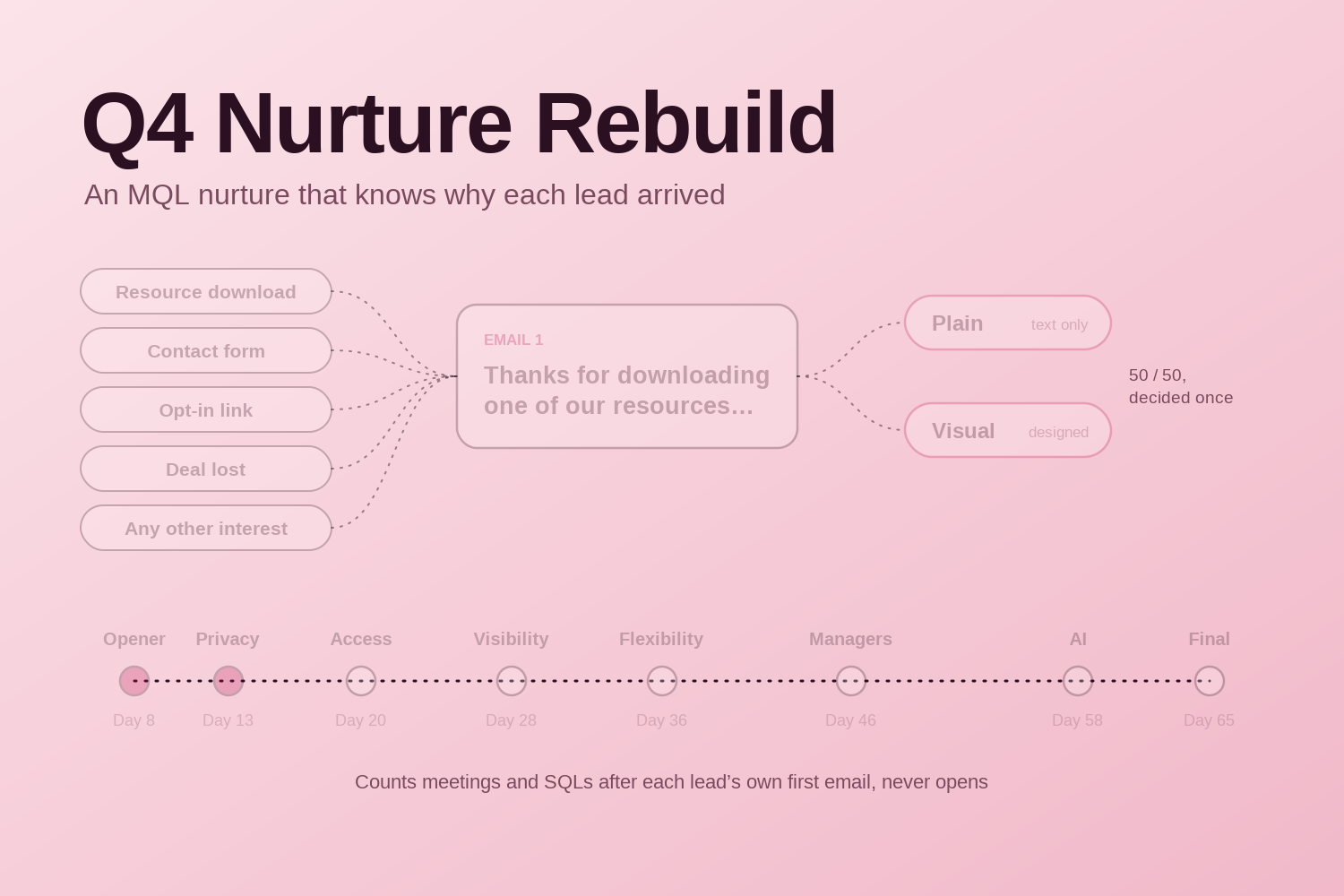
Final Outcome Overview
The new nurture went live in October 2026 and replaced a 30-email campaign. Every lead now enters through one of five entry points, gets a first email that references what they actually did, and is tested on a single layout question for the whole sequence. A reporting script and a dashboard spec were ready on launch day, and I handed the program over with full documentation once it was running.
Pain Point to Solve
At the B2B HealthTech company I work for, inbound MQLs went into a long persona-based nurture: three tracks, 30 emails in total, the same opener whether someone had downloaded a guide, filled in the contact form or just lost a deal. Nobody was measuring whether it moved anyone from MQL to SQL. When I analysed it, the signals were clear: people dropped off early, the most specific topics outperformed the generic ones, and several emails never earned a single click.
The analysis gave the brief for the rebuild: name the trigger in the first email, cut to about eight emails, keep only the topics that worked, and measure meetings and SQLs.
My Role
I owned the rebuild: the workflow design, the entry logic, the new properties, the test design, the cutover from the old campaign, the reporting script and the dashboard documentation. I reviewed the workflow over several rounds before go-live, then handed it over.
How It Works
Five entry points, one opening line. Leads come in from four sources: a new inbound conversion, the contact form, an opt-in link, or a deal moved to closed lost. On entry, a branch writes an entry reason to the contact, and email 1 opens with "Thanks for" plus that reason: downloading a resource, getting in touch, signing up, the time spent with the team, or a general fallback. I rejected a nine-branch design with one branch per asset as unmaintainable. The final version has five branches and a naming rule for download forms, so new assets are covered automatically. The reason is set once at entry, because the source field can change during the wait.
One test, decided once. After an eight-day wait, a 50/50 split sends each lead down a plain-text or a visual path for emails 1 and 2, and the variant is stored on the contact. HubSpot's built-in email A/B re-randomises on every send, so a contact could have seen mixed formats. Splitting once in the workflow keeps every person in one version. From email 3 the paths merge, and each email carries its own subject-line test.
Eight emails over about nine weeks. The sequence moves from an opener through privacy, accessibility, visibility, flexibility, manager support, AI and a final email, sent on business days in one send window that suits the mostly European audience. I documented when that should change: once the Americas pass about a quarter of entrants.
A cutover without double sends. HubSpot cannot filter on "currently in a workflow", so the new workflow unenrols each contact from the old campaign on entry. The old campaign stopped taking new contacts but let its last cohort finish, and contacts already on the lists were not pulled in.
Measuring What Matters
I wrote a Python script against the HubSpot API that reads every enrolled contact, their variant, lifecycle changes and meetings, plus the stats of all ten emails. Each contact is anchored on the moment their own first email went out, so a meeting or SQL only counts if it happened after it. A version becomes judgeable 25 days after email 1, results are labelled directional below 100 contacts per version, and opens are left out on purpose because Apple Mail Privacy Protection inflates them. The script produces aggregates only, a paste-ready Slack summary and an internal performance page, and it ships with a self-test.
HubSpot has no API for building reports, so I wrote a click-by-click guide for five dashboard reports, including how to talk about early numbers: "plain is ahead so far", never "plain wins".
Results
- 30 emails across three tracks replaced by one eight-email sequence
- 5 entry branches instead of 9, with an entry-specific first line
- One clean plain versus visual test, plus subject-line tests on six emails
- Reporting on meetings and SQLs from day one, with a self-tested script
- Live in October 2026; first readable results expected about a month after the first sends
Handover
The program is live and handed over with a technical page, the dashboard build guide and the reporting script. The open points I flagged at handover: sign-off on the deal-lost wording, confirming that replies to the sender inbox are logged in HubSpot, and scheduling the weekly report run.